
Milliseconds
Query response time for pre-computed digital twin views
Create always-current digital twins that give AI agents accurate, live context about your business entities. Connect operational systems, maintain fresh views through incremental updates, and expose structured data products via Model Context Protocol (MCP).
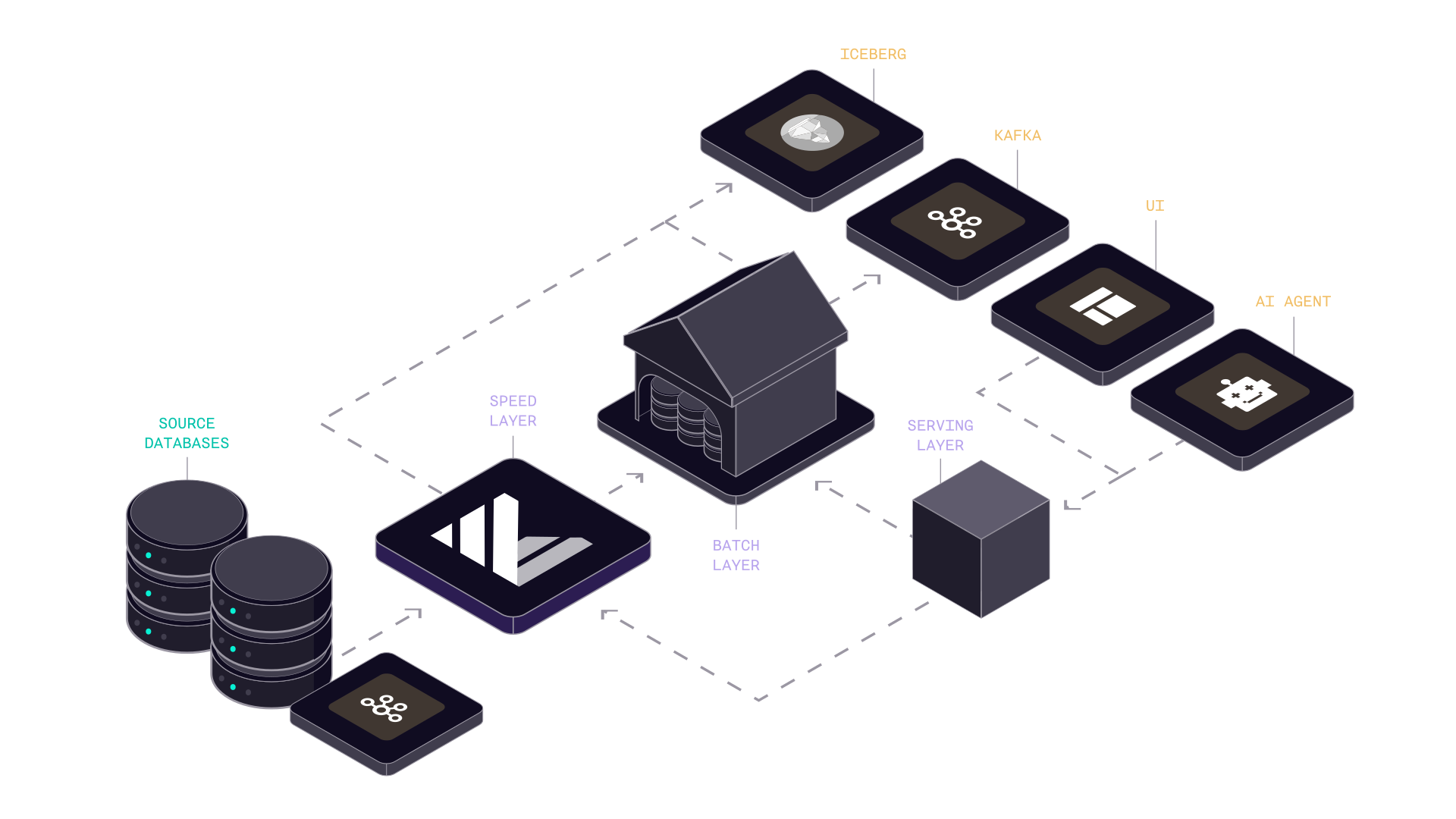
Build digital twins that maintain semantic business models in real-time, providing AI agents with structured, consistent context using the language of your business.
Connect a single operational database and create materialized views of key entities like customers, products, or orders. Define semantic models that abstract away table-level complexity and expose business concepts directly to agents.
Join data from ERP, CRM, inventory systems, and other sources to create comprehensive entity views. Build composite digital twin objects that represent complete business state rather than fragmented system-specific data.
Process event streams alongside database changes to capture state transitions in real-time. Enable agents to observe and respond to business events as they occur, maintaining tight feedback loops.
Build views on top of other views to create sophisticated business models. Compose simple entities into complex hierarchies that represent real-world business relationships and dependencies.
Surface digital twin entities as MCP tools with natural language descriptions. Enable agents to discover and query business entities using standardized protocols without custom integration work.
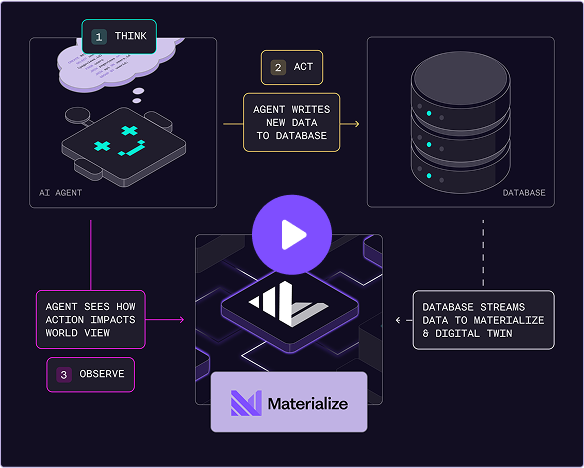
A delivery service built an AI agent that shops for recipe ingredients by creating digital twins of products and customers. The system maintains real-time inventory views across fulfillment centers and customer preference models that update as orders are placed and delivered.
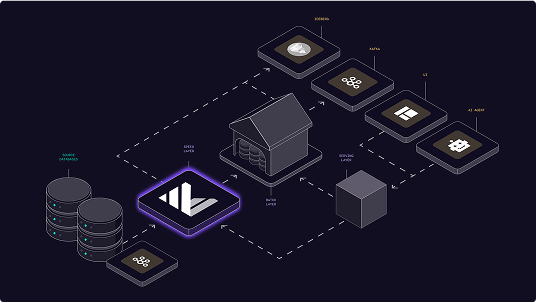
Materialize operates as a live data layer between operational systems and AI agents. Source systems stream changes via CDC, Materialize maintains incremental views of business entities, and agents query current state through MCP or direct SQL connections.
Understand the technical components that enable real-time digital twins for AI agent workloads.
Materialize updates query results as input data changes without full recomputation. Views stay current through efficient differential computation that processes only the changes, enabling real-time updates at scale.
Connect to operational databases, event streams, and APIs through CDC connectors. Source system changes stream directly into Materialize, maintaining sub-second data freshness across all connected systems.
Define business entities using SQL materialized views that abstract away source system complexity. Create customer, product, order, and other entity models that represent business concepts rather than database tables.
Surface digital twin entities as MCP tools with natural language descriptions. Agents discover available entities and query current state using standardized protocols, eliminating custom integration requirements.
Start with a single business entity and expand to comprehensive digital twin coverage. Follow proven patterns for connecting sources, defining entities, and exposing data to agents.